SpeedRunners 2 Movement Guide: Grappling, Sliding and Slope Jumps
Master SpeedRunners 2 movement: grapple swings and the golden hook, slides, wall jumps, slope jumps carried over from the original, and map mechanics.
FAQ
What is the difference between the grappling hook and the golden grappling hook in SpeedRunners 2?
Do advanced techniques from the original SpeedRunners work in the sequel?
What are the blue ceilings on SpeedRunners 2 maps?
How do I get faster in SpeedRunners 2?
Movement is the whole game. Pick-ups decide races occasionally; movement decides every race. The good news: SpeedRunners 2’s movement system is small — run, jump, slide, grapple — and everything else is momentum management. This guide covers each mechanic, the map features built around them, and the practice routine that fixes the most common speed leaks.
The Core Movement Kit
| Action | What it does | The skill |
|---|---|---|
| Run | Baseline speed | Take the racing line — the shortest path is rarely the fastest |
| Jump | Clear obstacles, reach wall-jump sections | Jump late and low; height costs distance |
| Slide | Stay low, keep speed through tight sections | Slide into downhill slopes to stack speed |
| Grapple | Swing from grapple points and blue ceilings | Enter and exit the swing without losing momentum |
| Wall jump | Climb wall-jump sections | Chain jumps without hesitating at the wall |
| Tackle | Barge rivals off their line | Timing at choke points — the official achievement “Get Out of My Way” tracks 10 tackles |
The Grappling Hook: Swing, Don’t Stop
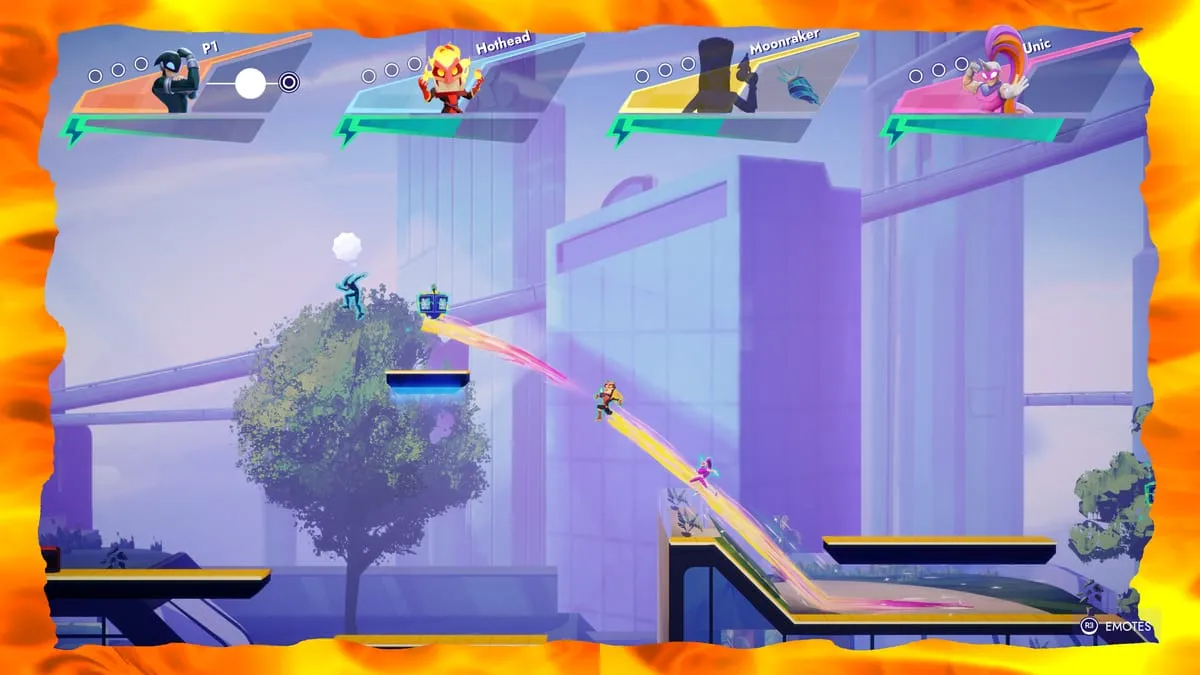
Your grappling hook is free, unlimited, and the single highest-skill mechanic in the game. Maps hang grapple points and blue ceiling sections over the main route: hooking them lets you swing over hazards and carry speed the floor route can’t match.
The skill is the exit, not the entry:
- Enter the swing early — hook the point before you need it so the arc adds speed rather than rescuing you.
- Release at the downswing — letting go as the swing carries you forward converts vertical motion into race speed; releasing at the top floats you.
- Chain points — the best routes hook two or three points in sequence without touching the ground.
Map ceilings aren’t decoration. If a stretch of track has a blue ceiling above it, the map is telling you the fast line is in the air — see the maps overview for how each mechanic shapes track design.
The Golden Hook Is Not Your Grapple
The golden grappling hook is a pick-up, and it does something completely different: it targets the runner ahead of you and drags them toward you. One tool moves you; the other moves your rival. New players burn the golden hook on a ceiling expecting a mega-swing and get nothing — the full interaction table is in the pick-ups guide.
Slope Jumps and Carried-Over Techniques
The official FAQ is explicit: the original game’s techniques — slope jumping among them — are preserved in the sequel, with the stated goal of matching the original’s mechanical depth. In practice that means:
- Slope jumps: leaving a downhill slope at speed launches you further than a flat-ground jump. Stack a slide into the slope, then jump at the bottom.
- Momentum conservation: techniques from the original’s competitive scene transfer — if you played SpeedRunners (2016), your muscle memory is an asset.
- Community-named techniques (like the Reverse Grapple) have their own page — the Reverse Grapple guide tracks the lesson, the original-game technique behind it, and what is verified so far.
Map Mechanics That Reward Movement
Every launch map is assembled from the same vocabulary, and each one answers a movement question:
- Booster pads — reward knowing the racing line; the fast route is the one that strings pads together.
- Blue ceilings — reward grapple confidence; the air route is usually faster.
- Wall-jump sections — punish hesitation; slow climbers lose the pack here.
- Levers — open and close pathways mid-race; knowing which route a lever leaves open is map knowledge that beats raw speed.
- Obstacles — reward clean, low jumps; sliding under beats jumping over where the map allows.
A 20-Minute Practice Routine
- Five minutes of tutorial campaign — re-run a grapple stage until swings feel automatic.
- Five minutes of bot races on one map — same map repeatedly, aiming to never leave the racing line.
- Five minutes of bot races with pick-ups only — practice throwing items mid-swing (see pick-ups).
- Five minutes online — pressure-test it. Expect the pack to expose any habit of stopping to aim.
Related Pages
- Beginner guide — rules and your first session
- Items and pick-ups — the golden hook and friends
- All maps — eight maps, sixteen layouts
- Playing with friends — bring the practice group
Gallery
Related Articles
SpeedRunners 2 Guides
SpeedRunners 2 Reverse Grapple: The Lesson, the Technique, the Legacy
The Reverse Grapple is SpeedRunners 2’s hardest tutorial lesson — the input checks, the technique’s original-game roots, and what is verified about clearing it.
SpeedRunners 2 Guides
SpeedRunners 2 Secret Achievements: The Four Hidden Map Secrets
SpeedRunners 2 hides four achievements — one secret per map: Museum, Metro, Casino and SS Royale. What Steam’s own data confirms, and where the gem hunt stands.
SpeedRunners 2 Maps
Casino Map in SpeedRunners 2: Layouts and the Royal Flush Trail
Casino returns in SpeedRunners 2, confirmed by the live build’s own data — an Expert-tier course in the original game. Layouts, theme, and the Royal Flush secret.
Next up
The Golden Grappling Hook in SpeedRunners 2: What It Does
The golden hook rewards precise swings — learn what it does and when to throw it.
Was this helpful?
Thanks for the feedback!